Dr. Doug Cardell
An Eclectic Economist Explains Evidentiary Economics
Clear Thinking in a Complicated World
“Ideology asks for acceptance—Intelligence asks for evidence.”
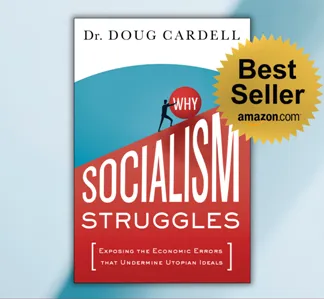
Why Socialism Struggles
Featured Article:


While butterflies may seem unrelated to economics, the butterfly effect, a key concept in chaos theory, plays a crucial role in understanding the complex and interconnected nature of economic systems. As I discussed in a previous article, 'Economic Error', this metaphor illustrates how small, seemingly insignificant events can have significant consequences in financial markets, global trade, and economic policies. The term 'butterfly effect' was coined by Edward Lorenz. Lorenz entitled one of his research presentations, "Predictability: Does the Flap of a Butterfly's Wings in Brazil Set Off a Tornado in Texas?" His presentation went on to show that the weather was a worldwide interconnected chaotic system that could never be accurately predicted. He showed how chaotic systems react to minuscule inputs with widespread, large-scale, unpredictable changes. His research proved that perfect weather prediction would require knowledge of every air and water molecule's position, speed, and direction, clearly an impossibility. After a decade of study, researchers realized that the weather would never be predictable more than two weeks in advance, and even that would be vague. In the previous article mentioned above, I made this challenge, "Every day for a week, look at the forecast in your favorite weather source and write down the basic facts for the weather a week ahead. Then, wait a week and compare the measured results with the predictions." I'll bet you'll find that even a week out, the results are sketchy, at best. Need more? As I'm writing this, in January in Arizona, I'm going outside every 10 minutes to see if the pipes are unfrozen and if there is any damage because the 31-degree forecast turned out to be seven degrees too high, freezing pipes prepared for down to 29 but not 24. The global economy operates as a single, intricate system, akin to the weather, where minor changes can set off chain reactions that reverberate across the economy, leading to extensive, unpredictable outcomes. This interconnectedness, like the butterfly effect in weather, is why economic predictions often yield conflicting results. To paraphrase Lorenz, Predictability: Can a shopper buying shoes in Peru precipitate a recession in Poland? Just as different weather forecasters differ in their initial assumptions, different economists make slightly different assumptions about the small inputs, and none can predict whether the individual shopper in Peru will buy that pair of shoes. Economic interconnectedness means that localized events can ripple across international markets in many areas. In the stock market, a slight change in the price of a single stock can have far-reaching effects throughout the entire market, potentially leading to significant shifts in the value of other stocks and financial instruments. In supply chains, the COVID-19 pandemic demonstrated how a localized health crisis could severely impact global supply chains, disrupting business operations worldwide and doubling lead times. In currency valuation, economic crises in one country can affect currency values in others. For instance, the Chinese financial crisis decreased raw material prices globally, pushing down foreign currency values of natural resource-producing countries like Australia, New Zealand, and Chile. That's not all. In commodity prices, changes in one country's economic situation can impact global commodity prices. For example, a slump in China's economy can decrease oil prices, affecting oil-exporting countries like Russia. Economic shifts in one nation can disrupt established trade patterns and trade relationships. When Russia experienced an economic downturn due to falling oil sales, Spanish wine producers found themselves with excess stocks originally intended for the Russian market. Sometimes, financial contagion causes economic crises to spread from one country to another through financial markets, trade links, and investor sentiment. This phenomenon can amplify the initial economic shock of a minor isolated event. The chaotic nature of economic systems guarantees their inherent unpredictability. All marketplaces are chaotic systems influenced by tiny changes, making it impossible to predict future outcomes. The successes and failures of businesses can appear random, with periods of economic growth and decline seemingly sprouting from nowhere. Small events can have disproportionate and unforeseen long-term effects on economic conditions. This complexity makes it impossible for policymakers and businesses to anticipate and prepare for future economic scenarios. Understanding the butterfly effect has significant implications for business strategy. In a chaotic economic system, companies must be prepared to adapt to potential indirect effects stemming from seemingly unrelated events. This chaotic environment necessitates a broad, global perspective, as events in distant markets can significantly impact operations. Companies and investors must diversify their investment and business strategies to protect themselves from uncertainty. This adaptability is crucial in a chaotic economic system, where the most desirable outcome often results from the market's natural diversification. The chaotic nature of economic systems underscores the need for flexible and adaptive economic policies. Policymakers must acknowledge that interventionist policies based on the assumption that the outcomes of those interventions are knowable are unreliable. Chaos theory proves they are not accurate. Policymakers should not ignore the potential for minor changes (the butterfly) to cascade into systemic catastrophes (the tornado). Instead, they should design policies that can respond to unexpected developments triggered by seemingly minor events. The best way to do this is by letting the market react without intervention because free markets are the ultimate expression of diversification and rapid response. This diversification always leads to the most desirable outcome possible in the long run. While this economic chaos presents challenges, it also offers opportunities. The unpredictability of markets can create openings for innovative businesses to disrupt established industries in a good way. The more an economy is controlled, the less likely innovations will occur. And while change isn't always better, better always requires change. The butterfly effect in economics raises critical ethical considerations. Small changes in economic policies or market conditions can amplify wealth distribution, inflation, and personal and corporate incomes. Therefore, the government is ethically responsible for the damage caused by its policies, such as the 2021-2023 inflation. Businesses must consider their actions' far-reaching consequences, even when they seem minor or localized. Finally, larger economies like the US, China, and the EU have to be ethically aware that their policies affect not only their countries but those of the rest of the world as well. To summarize, the butterfly effect poses significant challenges to economic forecasting. My published research proves these forecasts are no better than random chance. Traditional economic models too often fail to correctly predict complex, non-linear relationships like those in the metaphor of the butterfly effect. Minor errors, omissions, or changes in initial data can lead to significantly different outcomes in economic projections. Since these errors compound, that is, build on each other, the further out the predictions are, the more likely they are to be unreliable. Why do we care about any of this? Because politicians campaign on their ability to "fix" or "improve" the economy. Since you must choose between candidates to cast your vote, your understanding is essential to the national economy. The butterfly effect is a powerful metaphor for understanding the chaos of modern economies' complex, interconnected nature. Businesses, policymakers, and individuals must adopt a holistic, global perspective when making economic decisions. While chaos introduces significant challenges in predictability and risk management, it also opens up opportunities for innovation and positive change. Understanding these risks and rewards is essential for making personal, business, and government decisions. Your consumer choices and the votes you cast on election day can change the world.
If you found this article stimulating, you'll probably love my book, Why Socialism Struggles. If you share my concern about creeping socialism, please share this article with other folks who might enjoy it and link to it on your social media. And please share your thoughts below. Dr. Cardell would love to hear from you.
Questions, Comments, Criticisms, or Witty Remarks:
Recent Articles
Newest to Oldest
Contact Us
Dr. Doug would love to hear from you:

Copyright © 2018 - 2026 DougCardell.com. All rights reserved.

![[Valid RSS]](valid-rss-rogers.png "Validate my RSS feed")
Responses